Archive: June 2012

This article should give you quick overview of Clayton Christensen’s ground breaking book Innovator’s Solution and then I will try to apply his point onto the web application industry.

The Concept of Disruptive Innovation

Citing from the book:

Disruptive innovations … don’t attempt to bring better products to established customers in existing markets. Rather, they disrupt and redefine that trajectory by introducing products and services that are not as good as currently available products. But disruptive technologies offer other benefits–typically, they are simpler, more convenient, and less expensive products that appeal to new or less-demanding customers.

Disruption has a paralyzing effect on industry leaders. With resource allocation processes designed and perfected to support sustaining innovations, they are constitutionally unable to respond. They are always motivated to go up-market, and almost never motivated to defend the new or low-end markets that the disruptors find attractive. We call this phenomenon asymmetric motivation.

You should definitely take a look at Innovator’s Solution, it’s great book and has more interesting concepts in it like the cycle between integration and modularization in an industry or the job to be done approach to business strategy.

I will introduce you to two key concepts of the book – low-end and new-market disruption.

Low-end Disruption

Low-end disruption, as described by Clayton, starts at the low end of the existing market. But the lower price is a result of new business processes not just lower margin on the same process employed by established market players.

One example of this strategy may be Walmart and other discount stores that offer their customers cheaper goods but compensate the lower margin via much larger amount of sold inventory and quicker turnover of inventory. So they may have lower margins than traditional stores, but they turn it over three times faster thereby more than making up for it. And then there are all the elaborate logistic things Walmart does, going so far as to direct their suppliers businesses in some ways.

Another example may be personal computers, which were low-end disruption relative to the mainframes. Or now the tablets (iPad) which are disrupting the PC.

The key is that there are overserved customers in the existing markets that are willing to let go of some features of the product in exchange for lower price, simplicity, convenience etc.

Established players are motivated not to fight with the new entrant as he is attacking the least earning portion of their business.
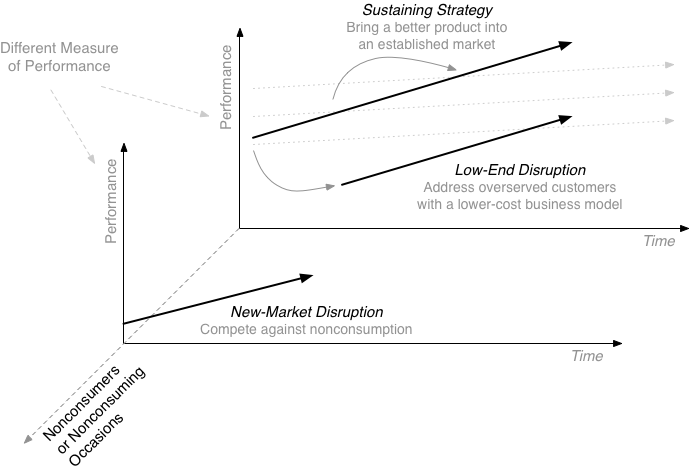
Two kinds of disruption

New-market Disruption

The target group of new-market disruption are non-consumers or non-consuming occasions. The disruptor is somehow able to transform existing product and get the new consumers.

Example might be the first transistor radios that were too low quality for the existing customers but were great for teenagers who were able to listen to what they wanted for the first time. And they allow everyone to listen on the go or outside home, which was impossible before.

The best thing from the point of view of the disruptor is that established market players ignore you for a long time because you are not eating their lunch. At least not for some time. And then it is too late for them.


OK, this was really quick and simplifying intro, again, read the book and/or watch the videos linked bellow.

In part 2, I will look at the implication of all this on the market of web applications.

Other sources

This so cool: Valve helps you create animated movies.

Via @daringfireball


Mandrill is a new way for apps to send transactional email. It runs on the delivery infrastructure that powers MailChimp.

We are currently using Postmark and it works great but as the job-to-be-done here is quite well defined and the APIs are reasonably simple, I’m sure it will be race to the lower price pretty quickly for these guys.

I like the modularization of the web application infrastructure we are seeing being build. And one has to wonder: What will be the inevitable integration about?

Great tutorial by Mary Lou of Codrops.


Select2 is a jQuery based replacement for select boxes. It supports searching, remote data sets, and infinite scrolling of results.

Good article by Patrick Cox of Codrops, about these elements of pricing page:

  1. Separate packages
  2. Make your offer stand out in the crowd
  3. Clear, honest and attention-grabbing type
  4. Benefits comparison
  5. FAQ’s
  6. The left-to-right/right-to-left debate
  7. Trust

My translation of this video: “Look, we are no longer able to even recognize that we are lying to you and we are bragging about it as openess.”

Via Ivan Kutil on G+

John Gruber (Daring Fireball) in one of his best pieces yet.


Microsoft Surface is not fundamentally about Microsoft needing to control the entire integrated product in order to compete with the iPad on design. It’s about Microsoft needing to sell the whole thing to sustain its current profitability.

If I’m right, it’s inevitable now that Microsoft will acquire Nokia.

Trust me, just read it.


Yesterday’s reveal of Surface, Microsoft’s first personal computer, was a watershed event in the evolution of value chains around computing.

And so we can see value chains evolving in real time before our very eyes. They have always evolved but in technology industries they evolve far more rapidly and will continue to accelerate.

The evolution of the computing value chain, Asymco

I found it interesting that the video is so, shall I say, technology-oriented? The magnesium body is presented as the main feature as we are wathing the dust turn to liquid metal blobs jumping and orbiting one another while the aggressive electro music is playing.

For Microsoft’s sake, I hope this is just the result of them not having been able to show what you can actually do with this thing right now, as the OS is some 5 4 months from releasing.

Source Microsoft Surface

Nestable is an interactive hierarchical list. You can drag and drop to rearrange the order. It even works well on touch-screens.

Via @smashingmag


AngularJS lets you extend HTML vocabulary for your application. The resulting environment is extraordinarily expressive, readable, and quick to develop.

Worth a look.

I know only two book from his list, The Innovator’s Dilemma and The Innovator’s Solution and I highly recommend them too, especially the Solution.

Another great epizode of Critical Path where, among others, such topics as Apple, China, industrialization, “Google has no friends” and others are connected by Horace Dediu.

I tweeted that I don’t think the checkboxes Facebook uses in its Messages section (below), are the best way to go about the problem. I suggested using the icon itself as the toggle for this job.

I come up with a rough draft. Obviously, it would need more thinking and knowing more about Facebook’s style guide, but you get the concept.

There were some interesting comments…

 
So here is my line of thinking.

What is the job here?

Facebook wants its users to be able to know that they can:

  • Send the message to mobile phone
  • Switch the Enter key mode

And at the same time allow them to do it.

Both the jobs are complicated enough, we can safely presume, it is impossible to design something that enough users will get the first time they see it. That’s precisely why Facebook has a tooltip in place when you hover the icon or the checkbox. That’s something I would keep.

Now, for the “allow the user to tell us, he wants to activate the function” problem.

What the user has to know?

First, what the user has to know to be able to use current solution?

  1. The checkbox is something she can click.
  2. The checkbox has two states (checked / unchecked).
  3. There is relationship between the icon and the checkbox on the left of it.
  4. When the checkbox is checked it means you want to activate the function the icon stands for and vice versa.

Quite low bets, granted, none the less, you can see there is some abstraction, mainly for the novice user you are trying to protect with “easy checkboxes”.

What the user needs to know to be able to use my proposed solution?

  1. It is something she can click.
  2. It has two states (on / off).
  3. When she clicks it toggles the state.

 
Back to the job we want to solve.

Less abstraction

I defined the job to be done here as letting the user know she can do something here, and giving her the tool to do it.

All in all, I think I removed some abstraction from the thought process our imaginary user has to go through: How the checkbox works.

I’m aware, that my solution introduces the problem that the user has to be able to distinguish between the two states (on / off), but I firmly believe that’s less abstract than the checkbox concept. It’s much closer to the working of physical button in the real world.

Looking forward to your comments.

UPDATED (June 12, 2012)

Jiri Jerabek tweeted his take on the toggle.

I would not show the label “Send to mobile” and stick with the current tooltip solution and the “Enter mode” toggle should look the same as the “mobile” one, but otherwise this is movement along the way I think it should be done.

22 guidelines written by Pixar story artist Emma Coats.


#2: You gotta keep in mind what’s interesting to you as an audience, not what’s fun to do as a writer. They can be v. different.

Nice catch by @rjs and as he said, it applies to product design too. Which is interesting if you think about it. Is product design storytelling in a way? Hmmmm…


Since we launched automated emails in Intercom, one of the most common use cases has been re-engaging customers who have stopped using a product. Let’s look at how to do that effectively. …


… Activity churn is where the rubber hits the road. Typical Churn stats use account cancellations as a measurement but cancellation is only ever a trailing indicator. It’s the last thing that happens.

Churn, Retention, and Reengaging Customers, The Intercom Blog

Some good tips for email communication included.

If this is for real, someone will quickly buy them.

Via @ondrejvalka

Clever man Horace Dediu and his presentation on Mobilism 2012. You are listening to his podcast Critical Path, aren’t you?

Nice UI for a “volume” dial built on jQuery.


